
Bird Families of Southwest Idaho – Wading Birds
- SIBA Communications
- Dec 1, 2025
- 4 min read

By Louisa Evers
Southwest Idaho hosts a wide variety of bird species, although the number of species varies by habitat and season. This series will discuss several of the families of birds and what species can be found here at least part of the year. Topics covered will be characteristics of a given bird family, what genera are present, and touch on what species of each genus are typically found here.
Wading birds covers several families of birds. Basically, these are the large, long-legged birds that are not shorebirds or waterfowl. This group includes herons, egrets, bitterns, night-herons, and ibis.
All the wading birds we typically find in southwest Idaho belong either to the family Ardeidae (herons, egrets, and bitterns) or Threskiornithidae (ibis). The Ardeidae have long, pointed bills and seize their prey with lightning-fast jabs. They typically stalk their prey slowly and methodically and usually fly with their necks folded back. The Threskiornithidae feed by probing into mud or sweeping their bills through water and fly with their necks stretched out. While the wading birds are most associated with still or slow-moving water, such as ponds, small rivers, lakes, and marshes many can also be found in fields, both flooded and dry. Some are migratory but several are year-round residents. There are also two wading birds that can appear as vagrants, usually in late summer and fall. Members of these two families found in Southwest Idaho fall into six genera.
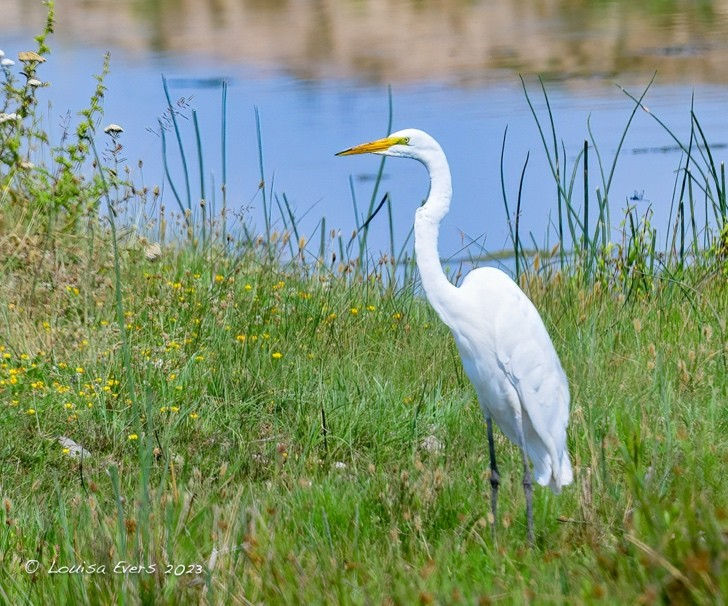
The Great blue heron and Great egret belong to the genus Ardea. The Great blue heron (Ardea herodias) is our largest wading bird. Great blue herons have blue-gray bodies, black flight feathers in the wings, grayish necks with fine black streaking on the underside, white in the face, a black “pony tail”, and short- gray plumes on the lower neck and breast. Some birds also have red or red and black at the wrist. The undersides and short tail are black. The smaller Great egret (Ardea alba) is all white with a yellow bill and black legs and feet. Most Great egrets migrate in the fall, but some stick around through winter. Both birds nest in colonies in trees and may nest as pure colonies or mixed together. Both can be seen feeding in flooded and dry fields as well as in water and will eat anything they can get down. The most common prey includes fish, small rodents, and snakes.
Great Blue Heron

Great Egret
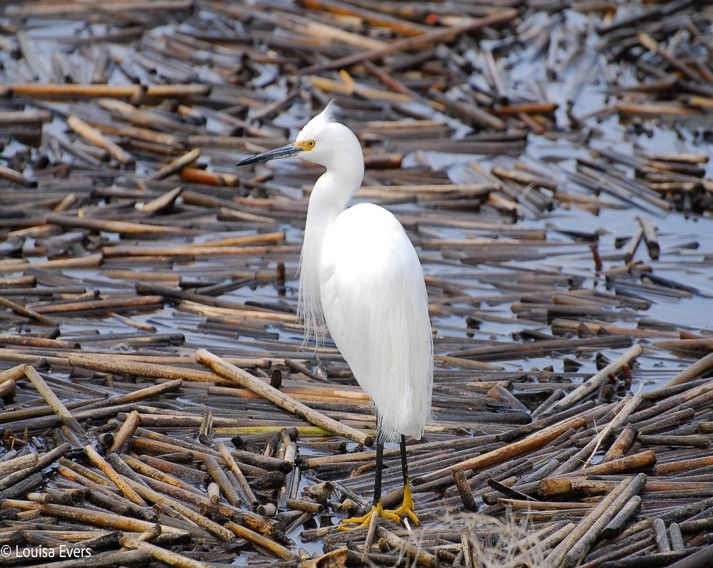
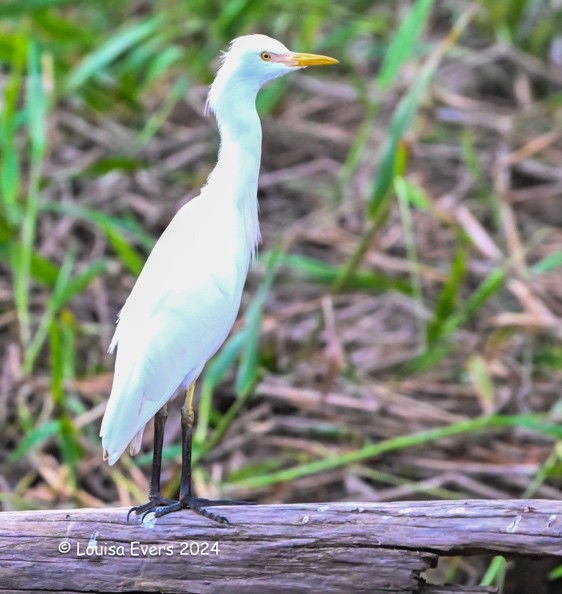
Two vagrant egrets that can be seen in some years are the Snowy egret (Ergretta thula) and Cattle egret (Bubulcus ibis), typically seen in late summer or fall when they appear. Both egrets are white. The Snowy egret has a black bill, black legs, and yellow feet, which help distinguish it from the Great egret along with its smaller size. Snowy egrets are more strongly associated with water but can be seen in dry fields. Cattle egrets are very small white egrets with yellow bills, legs, and feet and are found in uplands, often associated with cattle. Cattle egrets were unknown in the United States until 1952, expanding from Africa to South America to North America.
Snowy egret
Cattle egret
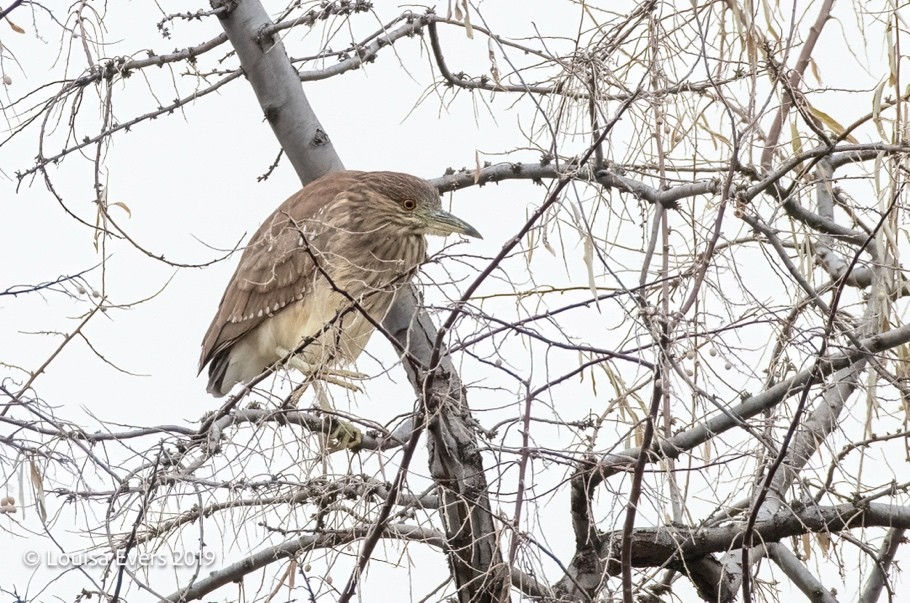
The Black-crowned night heron (Nycticorax nycticorax) is a small black, white, and gray heron that is quite secretive during breeding and more visible in fall and winter. Most often we see them hunched and still in small trees with dense branches as these birds are most active at dusk and night. Another name for this bird is the qwauk bird, based on its call. Adult Black-crowned night herons have black crowns and backs, gray bodies, white foreheads, faces, and necks, and two to three white plumes coming off the back of the head. Their bills are black, legs and feet are yellow, and eyes are red. Juvenile, or immature birds are mottled brown with yellow bills with a dark line on the upper bill and a dark tip, yellow legs and feet, and orange eyes.
Black-crowned night heron adult

Black-crowned night heron - immature
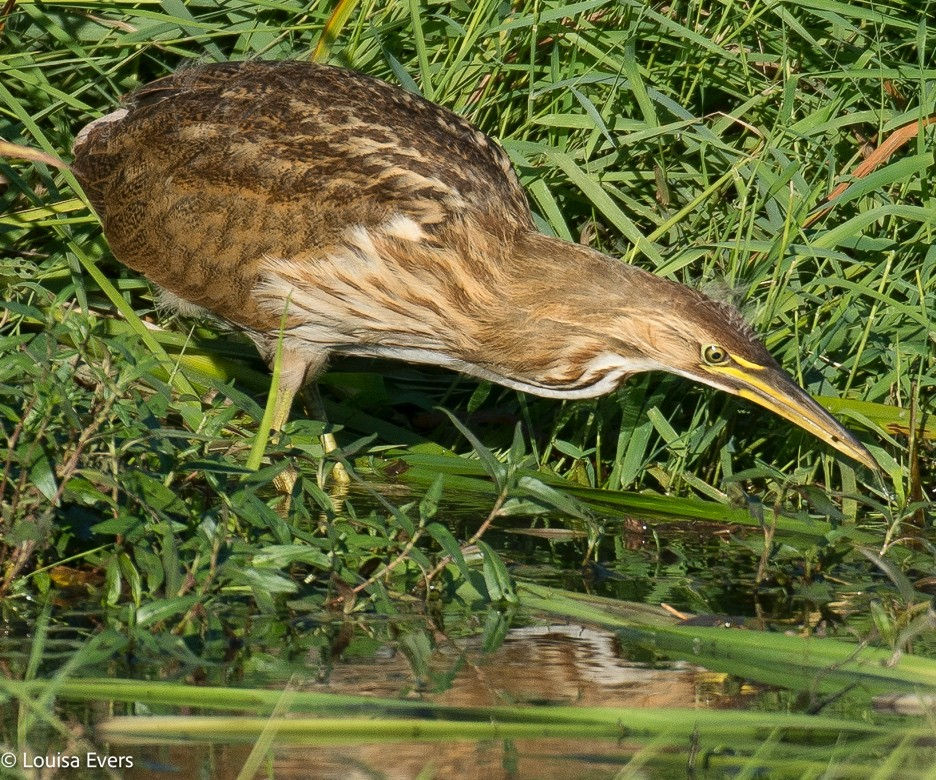
The American bittern (Botarus lentiginosus) is our least common member of the Ardeidae in southwest Idaho aside from the the two vagrant egrets. It is more commonly seen at Camas Centennial Marsh than anywhere in else in this part of the state. Bitterns are brown with long, thick necks and short legs, white “eyebrow”, chin, and throat, yellow eyes, mostly yellow bill, and yellow to greenish-yellow legs and feet. It is known for its habit of pointing it’s bill straight up so that the streaked through resembles dried grass. Bitterns are found almost exclusively in marshes and tend to be more active at dawn and dusk. Bitterns typically migrate away in fall.
American bittern
Our last wading bird is the White-faced ibis (Plegadis chihi). We see these birds during spring and fall migration. The most distinguishing characteristic of this tall bird is the long down-curved yellow bill. Adult birds have dark maroon heads, necks, upper backs, and underparts. The lower back and wings are iridescent purple and bronzy green. The eyes are red and surrounded by white feathers that extend under the chin with pinkish or red facial skin. Immature birds are brown instead of maroon and less iridescent; they also lack the white feathering around the eyes and chin that give this bird its name. White-faced ibis feed in still water and flooded, or at least damp, fields on insects, snails, and small fish.
White-faced ibis - adult

White-faced ibis - immature



Comments